
China’s consumption stimulus entered a new phase in 2026, backed by the most coordinated policy effort in years. The central government renewed RMB 1.3 trillion in ultra-long special treasury bonds, of which RMB 250 billion supports the consumer goods trade-in program for cars, appliances, and digital product upgrades.
The consumption stimulus subsidy policies to run on two tracks. The first is designed for businesses. The state pays part of the interest on loans taken out by consumer service industry, such as restaurants, stores, and tourism operators, and January’s upgrade raised the loan amount eligible for the subsidy from RMB 1 million to 10 million per company. The other track is designed for individual consumers, and the approach is similar. The state pays part of the interest when a consumer borrows to spend, with the scheme running through the end of 2026. January’s upgrade raised the per-transaction cap from RMB 500 to 3,000 and brought credit card installments into scope, a design that favors big-ticket purchases such as home furnishing and consumer electronics.
The stimulus targets the households most likely to spend it
The design logic sits in who receives this money. Young families, rural residents, and pensioners have the highest marginal propensity to consume, so cash reaching them goes straight into spending.
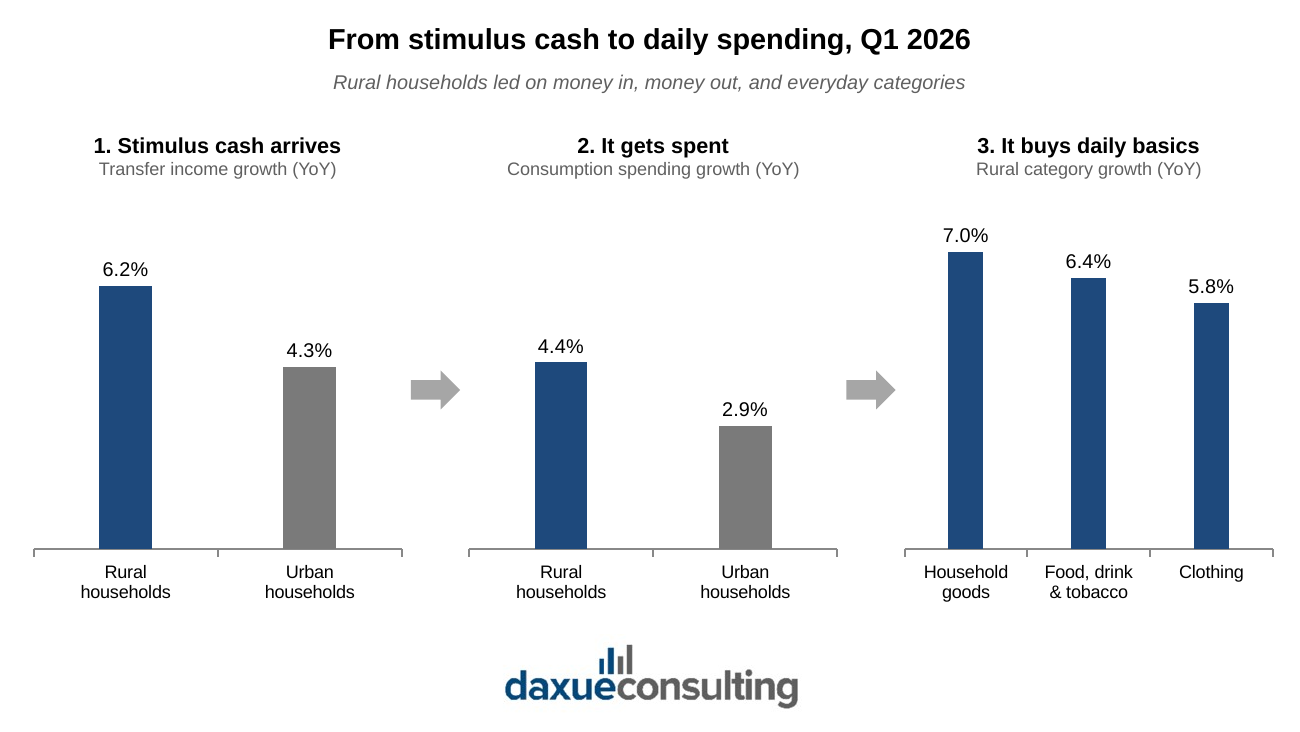
Subsidy payouts are what’s called “transfer income”, which is money from the government in the form of benefits. In Q1 2026, higher transfer income has correlated with higher consumer spending, indicating a direct effect on spending from subsidies. In Q1 2026, rural transfer income grew 6.2% against 4.3% for urban households. Spending followed the same order. Rural consumption rose 4.4% against 2.9% in cities, and 3.7% against 2.0% in real terms, close to double.
Following the stimulus, in Q1 2026 rural per-capita spending on household goods and services grew 7.0%, food, drink, and tobacco 6.4%, and clothing 5.8%, each running ahead of the overall rural pace of 4.4% and ahead of the same categories in cities. This data indicates that the households whose transfer income grew fastest are spending it on daily needs.
China’s consumption stimulus arrives in the form of dozens of local programs
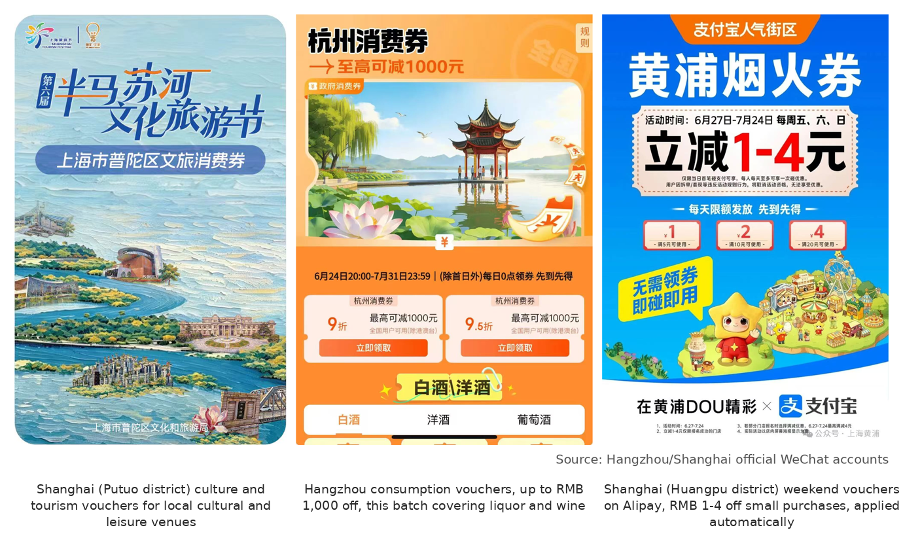
The central government picks the stimulus category and distributes the money, then local governments decide where their own share goes. This is usually into the sectors their economy already leans on. For example, Shanghai put its RMB 500 million voucher budget into dining, film, tourism, and sports, fit for a city that earns most of its GDP from services. Whereas Guangdong reserved part of its culture-tourism vouchers for visitors from outside the province, using them to pull in new customers. What this means for a business owner depends on the city.
In simple terms, an investment in Shanghai’s dining industry this year comes with the voucher program at its back, and the support is measurable, with culture-tourism vouchers generating RMB 7.2 in spending for every RMB 1 issued, so the invertor has a greater chance to see their money back.
The rural market has a different problem to solve
Rural consumer spending is already growing faster than in cities, with rural retail sales up 4.1% in 2025 against 3.6% in urban areas. What has held rural retail back is delivery. Rural shoppers pay more for shipping and still wait longer than city buyers. That gap continues to narrow. Parcel delivery now reaches 100% of counties, 348 county-level logistics centers and 562 township stations were added in 2025, and more than 30% of rural parcels move through shared delivery routes that split costs among couriers. With shipping costs coming down, rural retail has room to keep outgrowing urban. McKinsey expects about 66% of China’s personal consumption growth through 2030 to come from lower-tier cities and county markets, and county shoppers are moving from generic goods toward brands at accessible prices, which puts value brands first in line.
China’s consumption stimulus is rotating from goods to services, and the silver economy is where both meet
The trade-in program, the main goods-side lever of 2024 and 2025, has already done most of its work. Its subsidies moved car and home appliance purchases forward into 2025, sales that would otherwise have spread across the next few years, so the 2026 round of stimulus now points at services.
The Ministry of Commerce built its year around a Service Consumption Season. Spending data had moved ahead of the policy. In the first half of 2025, revenue from smart elderly care services grew 33.7% and elderly smart wearables grew 32.6%, while most goods retail grew at low single digits. For 2026 the demand support sits with services, and durable goods brands will need to plan around a year without the subsidy push they had in 2025.
China’s 60-plus population reached 320 million by the end of 2025, or 23% of the total, and the silver economy stands at roughly RMB 8 trillion, heading for RMB 30 trillion by 2035. Disabled seniors receive electronic care vouchers up to RMB 800 a month.
The debut economy pays brands to open their first stores
The consumption stimulus in China also pays brands to open first stores, a policy known as the first-store economy (首店经济). Visiting a brand’s first store in a city has become a check-in ritual (打卡) for young consumers. A debut opening draws far bigger crowds than regular expansion, causing city governments compete for these stores with public money.
The central consumption action plan lists the first-store economy as a priority, and Shanghai runs the largest program. Its First in Shanghai 4.0 policy, released in March 2026, covers 30% of a debut event’s costs up to RMB 1 million, and a customs whitelist cuts clearance time for imported debut products by 80%. The spending shows up in store counts. Shanghai added 1,093 first stores in 2025, bringing its total to 8,472 since 2018, and 16.8% of the new batch were global or Asia-level debuts, which makes the city a launch platform for the region as much as a gateway to China. For brands that have been weighing the Chinese market, the entrance fee has been reduced, with central policy support and local subsidies covering part of the opening bill.
For international brands, this policy overlaps with the geography of inbound spending. Shanghai, Beijing, Guangzhou, Shenzhen, and Chengdu capture two-thirds of national tax refund sales, and these are the same cities paying brands to open there. A global first store in Shanghai collects the subsidy, the domestic foot traffic, and the tourist spending in a single location decision.
Key takeaways on China’s consumption stimulus
- The 2026 stimulus works through financing. The clearest signal is the personal loan subsidy cap rising from RMB 500 to 3,000 per transaction, a six-fold jump that only matters when the purchase is large, so cars, appliances, and home furnishing feel the push first.
- Income support goes to households that spend every extra yuan, and the results already show. In Q1 2026, rural transfer income grew 6.2% against 4.3% for urban households, and rural consumption grew nearly twice as quickly as urban, evidence that money sent down the income ladder turns into purchases within the quarter.
- One national policy becomes dozens of local alternatives, so whether a category gets support depends on the local government. Shanghai put its vouchers behind services, Guangdong reserved part of its budget for out-of-province visitors, and Henan spread its funds across daily retail. With culture-tourism vouchers generating RMB 7.2 in spending for every RMB 1 issued, provincial voucher calendars are worth tracking alongside platform promotion dates.
- Goods subsidies pulled tomorrow’s purchases into 2025, so the 2026 lane is services, and the silver economy sits where the two meet. Silver care services and devices grew above 30% in H1 2025, roughly six times the pace of goods retail, and with 99% of seniors aging at home, that demand lands on home products and home services. Durable goods brands should plan for a payback year and attach services or senior lines to stay in the flow.
Author: Allison Malmsten, edited by Ming Yii Lai, with additional research by Zekai Zhang