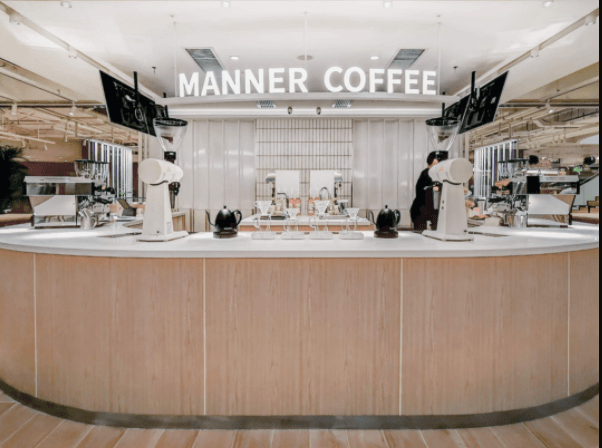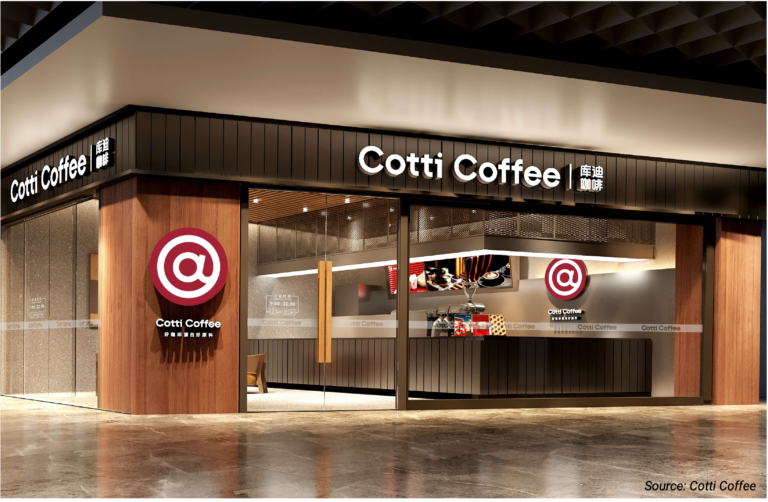


Chinese consumers are drinking coffee more regularly. According to a 2025 iiMedia survey, 36% of respondents drink coffee four to six times a week, while 29% drink it every day. This is particularly the case among the younger generations and urban professionals. While drinking coffee while studying or working is the main occasion in China’s coffee market, there are other occasions receiving attention. For example, people drink coffee while relaxing with friends, traveling, and driving. For some Gen Z, coffee is also a “social currency” or a “lifestyle symbol”, driving them to visit coffee shops for their aesthetic and experiential value.
Download our China emerging-tier cities report

As coffee becomes more deeply integrated into everyday life – not only in major cities but also in emerging cities – the coffee market is expected to continue to record single-digit annual value growth. In 2025, China’s coffee market size reached RMB 354.9 billion, while the annual average coffee consumption per capita was 28.57 cups. This positions China as one of the world’s top ten coffee-consuming countries by total volume, although its per-capita consumption remains relatively lower compared to more mature markets like the United States and Europe.
How the coffee market is segmented by category
When it comes to coffee category choices, Chinese consumers are showing greater diversity compared to the historically demand for instant coffee. According to a 2025 iiMedia survey , 55.7% of Chinese consumers regularly had coffee purchased from coffee shops like Luckin Coffee and Starbucks. Freshly brewed coffee appealed to them for its quality and experiential appeal. Instant coffee followed closely behind at 44.9%. With its ultimate convenience and cost-effectiveness, it can be found in abundance in office drawers, home cupboards, and travel luggage. The instant coffee market continues to become increasingly segmented, with new types such as freeze-dried black coffee, cold-brew concentrate, and nitrogen-sealed ready-to-drink coffee emerging.
In addition, hand-drip coffee accounts for 36.6%, while bottled ready-to-drink coffee (33.2%) and capsule coffee (24.7%) fill the gap between convenience and quality on specific occasions such as workplaces, daily commutes, and business travel.
How health awareness impacts coffee consumption
More and more consumers are placing greater emphasis on health-conscious options. Low-sugar, low-fat, and additive-free products have gradually become the mainstream in the market, and coffee products rich in antioxidants, dietary fiber, and other nutrients are increasingly favored.
In April 2026, Starbucks became the first major brand in the Chinese coffee market to introduce health-focused coffee products. It launched its new High-Protein Latte Pro series. Health is no longer a substitute for flavor but an independent consideration that goes hand in hand with it—and at the same time, innovations aimed at achieving the ultimate flavor continue to emerge at an ever-faster pace.
What the demand for fruit-infused coffee says about coffee consumption
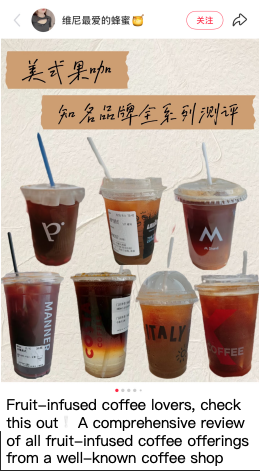
In terms of coffee flavors, consumers are increasingly diversifying their choices, with categories such as fruity and mixed-flavored coffees, which offer rich, layered taste profiles, experiencing rapid growth. This shift signals that consumers have moved from seeking single-purpose products to seeking personalized experiences.
Fruit-infused coffee has become the main battleground for various brands. Starting with Luckin Coffee’s Orange Americano, other brands such as Cotti and Starbucks have also gradually begun to innovate with fruit-infused coffee. Tim Hortons Coffee launched the Dongkui Bayberry Americano in 2025, and it was reintroduced in June 2026 as the year’s must-try bestseller.
Coffee and cultural tourism: Emotional value drives new growth in consumption
“Village cafes” specifically refer to unique rural coffee shops nestled in the mountains and countryside of ancient villages and pastoral scenic areas, and they have been named one of China’s Top 10 Internet Buzzwords of 2025.
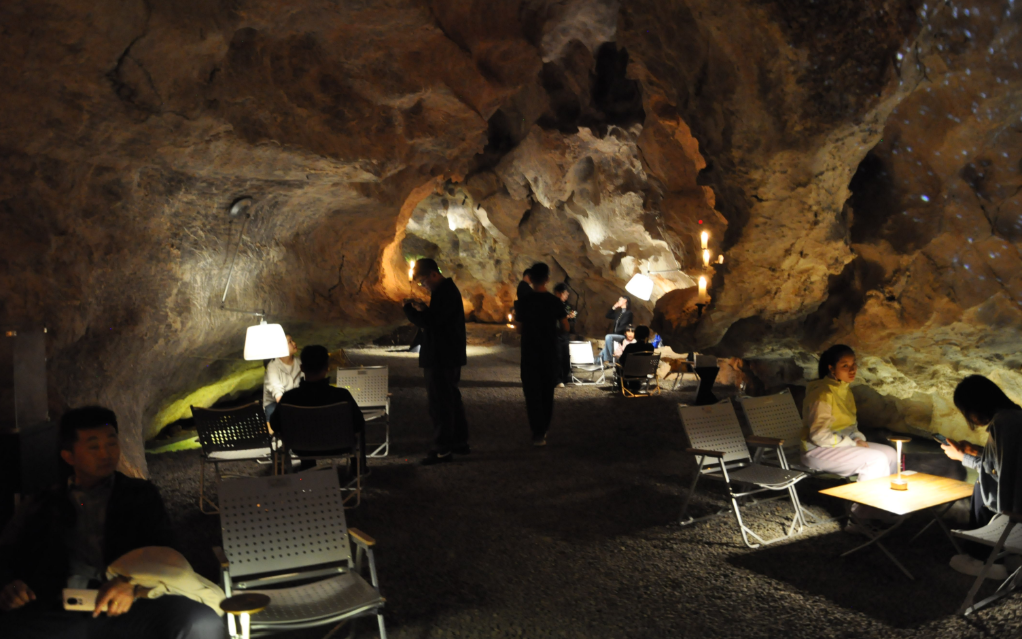
In Guizhou, cave cafes have become a phenomenon. The Chuanxi Camping Base has opened a cafe inside a natural limestone cave deep within a canyon. Its core value lies in the scenic and atmospheric experience provided by the natural cave landscape.
Leveraging its natural advantage as the nation’s largest coffee-producing region, Pu’er, Yunnan, has created immersive coffee tourism experiences such as estate coffee, mountain forest coffee, and rice paddy coffee. In the first half of 2025, the region welcomed more than 340K visitors, with the average length of stay increasing from 2.57 days to 3.12 days. Coffee in China is no longer confined to city office districts and shopping malls. It connects urban consumption habits with rural tourism, natural scenery, and local cultural identity.
Meanwhile, coffee festivals in various cities have also become an important way to attract tourists. The 2025 Lujiazui International Coffee Culture Festival has grown from 24 participating brands at its inaugural event to over 300, serving a cumulative total of 850,000 in-person attendees. It has also helped Australian brands open their first stores in China and led local brands in expanding into the London market. Coffee festivals have evolved from a few days of consumer extravaganza into an effort to foster a larger industry chain. In addition, coffee festivals not only generate on-site spending but also drive broader consumption growth by collaborating with nearby commercial districts and offering consumer incentives. Coffee festivals are evolving from single cultural events into a citywide economic engine that drives cultural and tourism consumption.
How the industry is changing to satisfy evolving demand and survive
China’s coffee industry is transitioning from 2024’s price wars and rapid expansion toward supply chain consolidation and customer retention through 2026.
By 2025, it entered a new stage of growth. Coffee chains grew through rapid expansion into lower-tier cities and product innovation across flavors and formats. Domestic brands such as Luckin Coffee and Cotti entered an era of 10,000 stores, increasing coffee store concentration significantly. The proportion of stores in lower-tier markets rose from 37% in 2024 to 43% in 2025, and over 9,300 new stores opened in county-level areas, indicating that the market’s potential is being unlocked at an accelerating pace. Additionally, product innovation has been thriving, with tea-infused coffee, fruit-infused coffee, and functional coffee products emerging.
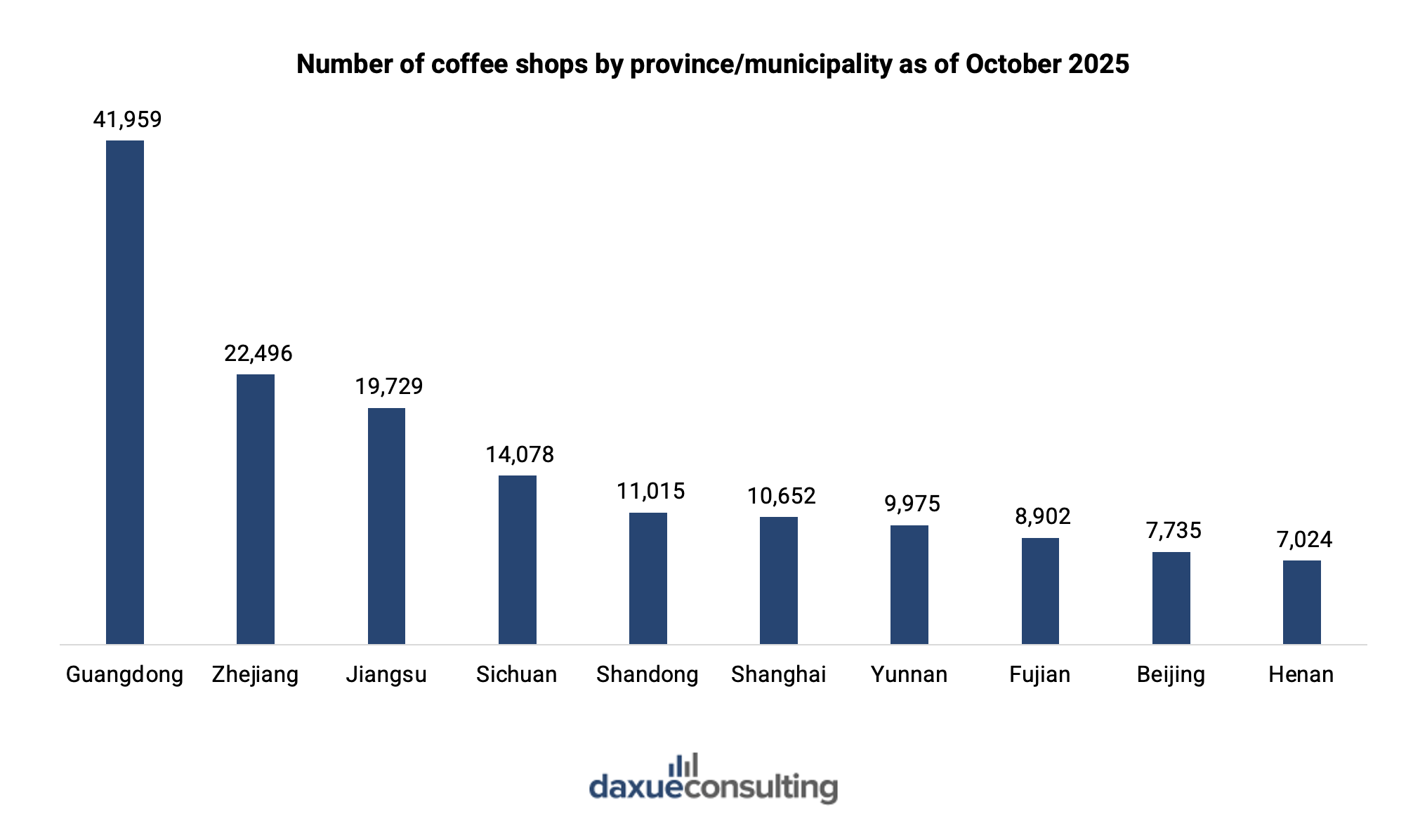
Data source: Canyandata, designed by Daxue Consulting, Number of cafes by province/municipality as of October 2025
However, certain drawbacks caused by rapid expansion and oversupply have gradually come to light. Although the price war began to wind down in early 2026, coffee prices have fallen to below RMB 5, severely squeezing the brands’ profit margins. The accessible premium coffee market has been struggling to compete with cheaper local chains. Seesaw entered bankruptcy proceedings, Tim Hortons’ losses widened, and Costa Coffee scaled back its store footprint.
The pressure extends beyond individual brands. From a regional perspective, although Guangdong has the highest number of coffee shops in China, its closure rate in 2025 remained high, ranking fifth among all provinces nationwide.
From being acquired to acquiring, Chinese coffee brands go global
Looking back at 2025 and 2026, capital operations in China’s coffee industry have evolved from early-stage brand investments to the systematic integration of global coffee assets. In November 2025, Starbucks announced the sale of up to 60% of its Chinese operations to Boyu Capital in a deal valued at about RMB 28 billion, making Starbucks China a Sino-foreign joint enterprise. Meanwhile, Dazhen Capital, Luckin Coffee’s largest shareholder, also acquired Blue Bottle Coffee, Nestlé’s premium coffee brand in 2026. These acquisition cases indicate that the investment strategy in China’s coffee market no longer focuses on the expansion of a single brand, but has shifted toward a hybrid strategy combining global brands with a China-specific model.
At the same time, Chinese coffee brands are also expanding overseas. By the end of 2025, Luckin Coffee had a total of 160 overseas stores, including 81 company-owned stores in Singapore, 9 company-owned stores in the United States, and 70 franchise stores in Malaysia.
Another major Chinese coffee chain, Cotti Coffee, has been named one of the Top 30 Global Flagship Brands in Forbes China’s 2025 Global Expansion List. In the short span of three years since Cotti Coffee expanded overseas, the number of its global locations has surpassed 18,000, with operations spanning 33 countries and regions across six continents, ranking it third globally. The global expansion strategies of China’s domestic coffee brands are primarily based on a local business model centered on exceptional value for money, quick service at small stores, and a focus on efficiency.
Insights that define China’s coffee market trends
- In 2025, the coffee market size reached RMB 354.9 billion, with rapid growth happening in China’s emerging cities. The proportion of stores in lower-tier cities rose from 37% in 2024 to 43% in 2025, and over 9,300 new stores opened in county-level areas.
- Health-conscious options and fruit-flavored coffee innovations are emerging as the two key trends.
- Experience matters as much as price. As the 2024 price war winds down, consumers seek experiential value – through aesthetic spaces, tourism integration, and innovative flavors.
- Coffee is expanding from traditional retail into experiential formats and cultural tourism.
Authors: Stéphane Badel and Sory Park, with additional research by Zhixin